
The 4 pm London fix and other benchmark rates

Most forex prices you see are live quotes. A few are different: they are single reference numbers calculated from a burst of trades, and large parts of the financial system depend on them.
The London 4 pm fix
WM/Reuters, now published under the LSEG name, calculates spot rates for a wide set of currency pairs at set times through the day. The most widely used snapshot is at 4 pm London time. Asset managers use it to value cross-border portfolios, index providers use it for their currency conversions, and many funds rebalance their currency hedges at that rate, because a benchmark price gives everyone the same number.
How the rate is calculated changed after benchmark manipulation cases came to light around 2013. Regulators in several countries investigated and fined banks, and in the UK the FCA fined five banks a total of more than one billion pounds in 2014. Following that, the calculation window was lengthened from one minute to five minutes around the fix time (a window of roughly 2:57:30 to 3:02:30 GMT for the London fix, per the published methodology at the time), and the way trades and quotes feed into it was tightened. A five-minute window makes it harder to move the number with a single burst of orders.
Month-end and the fix
Because so many flows are pegged to the fix, trading volume around it is high, especially at month-end when portfolios rebalance. Academic studies have reported price patterns around month-end fixes, and the exact size and persistence of them is debated, so it is better not to treat any of it as reliable.
ECB reference rates
The European Central Bank publishes euro foreign exchange reference rates once per working day at around 16:00 CET, based on a consultation between central banks at 14:10 CET. The ECB describes them as being for information only, not for transaction purposes. They are freely available as files and are a common source in accounting and reporting software, which is exactly why they cause mistakes when treated as a tradable price. Other central banks publish daily rates of their own with different times and conventions.
What this means for your data
- A "daily close" from a data vendor might be a last quote at a certain hour, a fix, or a settlement. These are different numbers, and their difference can exceed the spread. Label which one you store.
- When you compare your own results with a benchmark, use the same timestamp and the same side (mid or bid).
- Fix times are set in local time and move against UTC with daylight saving, and the US and EU changes fall on different dates.
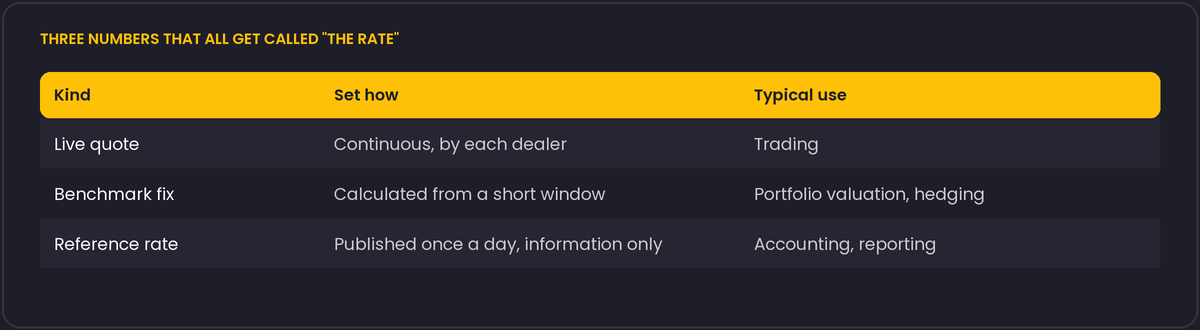
Before you use a rate in something that has legal or accounting weight, such as an invoice, look up which rate the contract or regulation names. In many cases it names a specific source and time, and using a similar-looking number from elsewhere is not the same thing.
More than one fix a day
The 4 pm London fix is the one most often cited, but it is not the only snapshot WM/Reuters (LSEG) calculates; the methodology covers a set of fix times through the trading day for different currency pairs, serving markets and time zones where a London-afternoon snapshot is not the natural reference point. Other markets have their own long-standing fix conventions entirely separate from the London one: a Tokyo fix around 9:55 JST is commonly referenced for Japanese corporate and institutional USD/JPY flows, tied to the local business day rather than to London's. A system that stores "the daily fix" as a single unlabelled field, without recording which fix and which provider's methodology produced it, cannot later distinguish a London 4 pm value from a Tokyo-morning one for the same calendar date, which is the same labelling discipline the earlier live-quote-versus-fix-versus-reference-rate distinction in this article already argues for, just extended across more than one fix per day.