What the US dollar index (DXY) actually contains
When someone says "the dollar is strong", the number they often point to is the US Dollar Index, DXY. It is worth knowing what is inside it, because it is narrower than the name suggests.
The basket
The index was created in 1973 by the US Federal Reserve's researchers, set to a base of 100, and today it is calculated and licensed by ICE. It has been changed only once, when the euro replaced several European currencies in 1999. The current weights are:
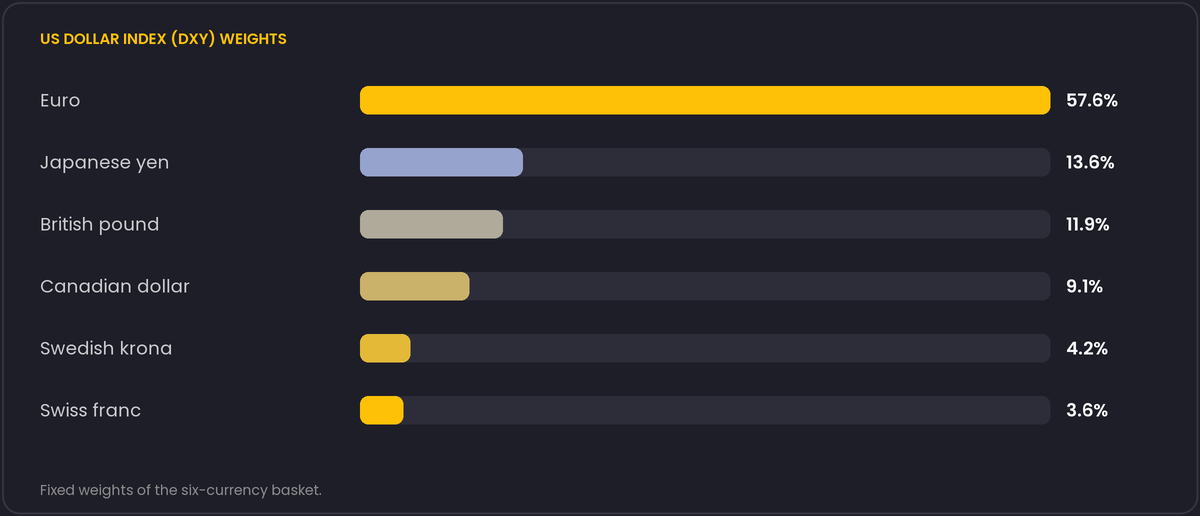
The six currencies are the euro (57.6%), Japanese yen (13.6%), British pound (11.9%), Canadian dollar (9.1%), Swedish krona (4.2%) and Swiss franc (3.6%). These add up to 100%. The chosen currencies reflect the trading relationships of the early 1970s and the basket has not been updated to include, for example, the Chinese yuan or the Mexican peso, which are among the largest US trading partners today.
How it is calculated
The index is a geometric weighted mean. In its published form it is a constant, about 50.14348112, multiplied by each exchange rate raised to its weight. Euro and pound enter as dollars per unit and get a negative exponent; yen, Canadian dollar, krona and franc enter as units per dollar and get a positive one. As a result, a rising dollar against any of them lifts the index, and the size of the effect is proportional to the weight.
What follows from the weights
- With more than half of the index in the euro, DXY moves largely opposite to EUR/USD. Looking at the two together is often looking at the same information twice.
- A "broad" dollar measure such as the Federal Reserve's trade-weighted indices includes a larger set of currencies with weights tied to trade. The two can diverge when currencies outside the DXY basket move.
- The index level is a chain of history. A value of 105 says that the dollar is 5% higher than at the base date in the geometric-mean sense, not that anything is 5% more expensive today.
It is not a spot price
There is no spot pair for the DXY. It is calculated from quotes of its components, and it can be traded through futures listed on ICE, with quarterly expiries. Many brokers offer a CFD that follows the futures price or a synthetic calculation. These can differ from the index figure, and CFD providers use their own rollover rules. If you store DXY history, note whether it comes from the calculated index, the futures or a broker CFD. Their differences are more than rounding.
Data source also matters for timing. Some historical DXY series are stamped in a broker's server time, so verify time zones against a known event before merging with other data.
Working the formula through
The geometric formula is more concrete with real numbers run through it. Taking EUR/USD at 1.0800, USD/JPY at 150.00, GBP/USD at 1.2700, USD/CAD at 1.3600, USD/SEK at 10.50 and USD/CHF at 0.8800, and applying the constant and the six weights from above:
dxy = (50.14348112
       * (eurusd ** -0.576)
       * (usdjpy ** 0.136)
       * (gbpusd ** -0.119)
       * (usdcad ** 0.091)
       * (usdsek ** 0.042)
       * (usdchf ** 0.036))
# dxy ≈ 104.14
The negative exponents on the euro and pound legs are what make the index fall when EUR/USD and GBP/USD rise (a stronger euro or pound against the dollar), while the positive exponents on the other four legs make the index rise when the dollar strengthens against them, exactly the "dollar strength against a basket" reading the index is meant to convey, and reproducing this calculation once against a source that publishes the live index value is a reasonable way to confirm you have the current weights and formula right before building anything that depends on matching the official number.