Why daily candles differ between forex brokers
You compare a daily chart from two brokers and the high of the same day is different by a few pips, or one shows six candles a week and the other five. Before suspecting bad data, check the definition of a day.
Where the day starts
There is no official forex day. Brokers choose it, and there are two common choices:
- New York close. The day starts at 17:00 New York time. Many MetaTrader servers implement this with a server clock that is GMT+2 in winter and GMT+3 in summer, so that server midnight lines up with 17:00 in New York. It gives five daily candles per week, from Sunday evening to Friday evening.
- UTC midnight or the broker's own local midnight. A few Sunday-evening hours then form a short extra candle at the start of the week, which is why some charts show a thin Sunday bar.
The two definitions cut the price history at different places, so daily highs, lows, opens and closes differ, and weekly candles can differ too.
Other reasons for differences
- Feed. Each broker aggregates quotes from its own liquidity providers, so the exact tick sequence differs. The highs and lows of a candle depend on which quotes were included.
- Side. Candles are usually drawn from bid prices. A provider that uses mid or ask prices produces different highs and lows.
- Spread handling. During the rollover hour some brokers publish widened spreads, and the bid may drop momentarily. That can create a low that other feeds do not have.
Aligning data in Python
Store everything in UTC, and build your own daily bars with an explicit definition of the day. A compact way to get the New York close convention, with daylight saving handled by the time zone database, is to convert to New York time, add 7 hours so that 17:00 becomes midnight, and take the date:
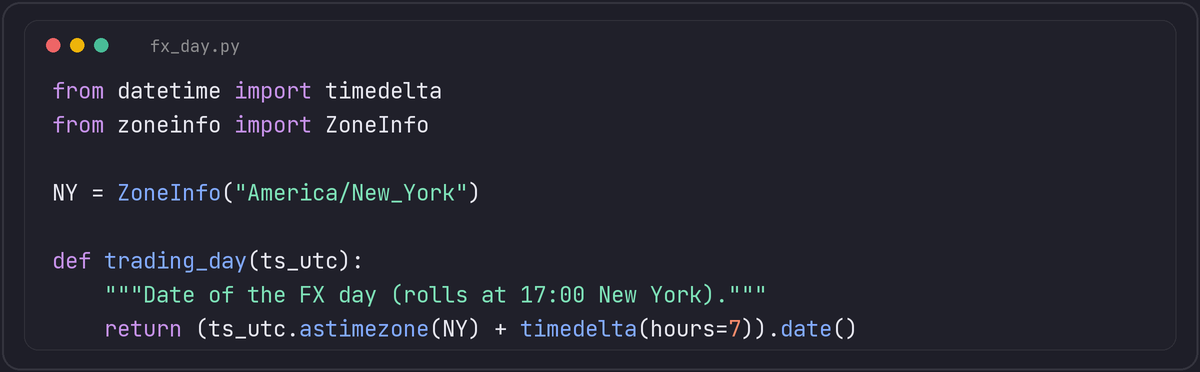
It works because 17:00 plus 7 hours is 24:00. In winter the last hour of the Friday session is 16:00 to 17:00 New York, which is 21:00 to 22:00 UTC, and the code assigns it to Friday. With pandas the same idea is tz_convert('America/New_York'), a shift of the index by 7 hours, and resample('1D').
A checklist when numbers disagree
- What time zone and offset does each source use, and does the offset change with daylight saving?
- Where does the day boundary sit?
- Is the series bid, ask or mid?
- Did you compare the same number of candles for the week?
Once you fix the definition in your own code, results become reproducible across brokers, and any remaining differences are the feed differences, which are small compared with a misaligned day.
The UTC-midnight alternative, in code
The New York-close convention above is the more common one among retail brokers, but a UTC-midnight day, or a broker's own local midnight, is simple to compute for comparison, since it needs no timezone conversion at all:
def trading_day_utc(ts_utc):
    """Date of the FX day under a plain UTC-midnight convention."""
    return ts_utc.date()
Running both functions over the same tick data and comparing the resulting daily bars is a quick way to confirm, for any specific pair of data sources, which convention each one is actually using, rather than trusting documentation that may be outdated or simply wrong: build daily bars under both definitions, and see which one matches the broker's own published daily candles more closely. Weekly bars inherit the same ambiguity one level up, since a week built from New York-close days starts on Sunday evening New York time, while a week built from UTC-midnight days starts at Sunday 00:00 UTC, roughly a day different depending on the season, so a discrepancy in weekly candle counts between two sources is very often just the daily-boundary disagreement compounding across seven days rather than a separate problem to debug.