
Reading an economic calendar: actual, consensus, revised

Economic calendars look simple: a time, a country, an event and a few numbers. Each of those numbers has a different origin, and treating them as equivalent leads to data you cannot trust.
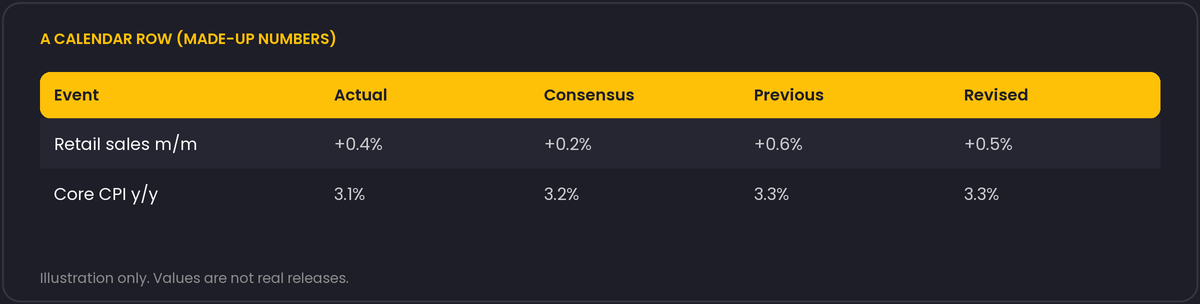
The columns
- Actual is the figure from the statistics office or central bank at release time. It is the only one that comes directly from the source.
- Consensus (or forecast) is a summary of economists' forecasts, usually a median collected by a data vendor or a news agency. It is not published by any official body, and two providers surveying different panels can show different consensus numbers for the same release.
- Previous is the last release of the same indicator. The important detail is that many indicators are revised, and providers differ on whether "previous" shows the original number or the revised one.
- Revised shows the change to the previous number, when there is one, and it is the reason the previous column deserves attention.
Why revisions matter
The first print of many series is an estimate that is later updated when more survey responses arrive. US payrolls, for example, are revised in the two following months and again in an annual benchmark revision. GDP goes through advance, second and third estimates in the US, and other countries have their own schedules. A calendar that overwrites the old number silently loses the information that the market reacted to the first print, not to the final one.
Storing it properly
For a system that has to keep history, one row per event is not enough. A design that survives revisions stores each release as a separate record with the time you learned it:
- the indicator and the reference period it describes (March, Q2),
- the value and the timestamp at which that value became known,
- a link to the value it replaced,
- and the source, since a wrong figure with no source cannot be corrected.
Then "what did the market know at 13:30 UTC on that day" is a query and not a guess. Backtests that use the final revised value for a decision taken on the first print use information that did not exist yet.
Small traps
- Year-on-year and month-on-month versions of the same indicator often share a name in a feed. Store the unit and the comparison basis.
- Headline and core measures are separate series (CPI and core CPI).
- Time zones: releases are published at fixed local times of the issuing country, so the UTC time changes with daylight saving.
- Holidays and delayed publications change dates, so schedules should be updated from the source and not generated from a rule.
The number a headline shows first is often just the actual against the consensus. A careful reader also looks at the revision to the previous month, since it can change the meaning of the new number.
A recurring, structural example: the annual benchmark revision
Some revisions are not occasional corrections but a scheduled, structural part of how an indicator is produced, and US nonfarm payrolls is the clearest example most calendar users encounter. The initial monthly print is estimated from a sample of business establishments; two smaller revisions follow in the two subsequent months as more responses arrive, and then, separately, an annual benchmark revision realigns the entire year's employment count against a much more complete administrative dataset (unemployment insurance tax records, covering nearly all employers, compiled with a considerable lag). Because the benchmark revision reconciles a sampled estimate against a near-census count collected long after the fact, it is a structurally different kind of correction from the two-month revisions, larger in scope and not a signal that the original monthly estimation process was flawed. A system that stores only the latest value for "nonfarm payrolls, March" cannot distinguish a market reaction to the original estimate from a market reaction to a benchmark-revised figure published more than a year later for the same labelled month, which is exactly the kind of confusion the revision-tracking design described above is built to prevent.