Spot forex has no real volume: what platforms show instead
Stocks trade on exchanges that report every transaction, so volume is a fact. Spot forex trades over the counter between banks, dealers and platforms, with no central record. Nobody can tell you how many euros traded against dollars in a given minute across the market, and the number on your chart is something else.
Tick volume
Retail platforms such as MetaTrader show tick volume: the number of price updates the broker's feed produced during a candle. It measures how often quotes changed at that broker, not how much was traded. The count depends on the liquidity providers connected to the feed and how the broker filters quotes, so two brokers can show different numbers for the same candle. Tick volume also often rises when activity rises, which is why people use it as a proxy, and a proxy is all it is.
Futures as the visible part
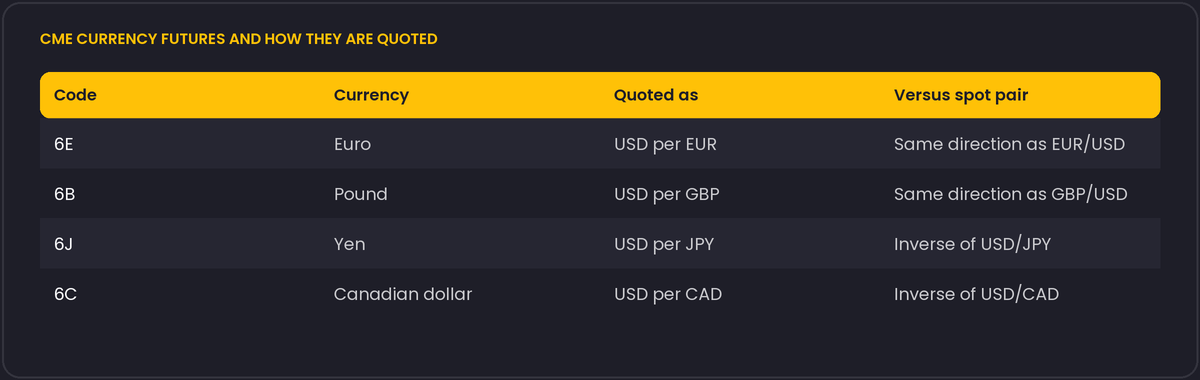
Currency futures on CME are exchange traded, so they have real volume and open interest, published daily. The main contracts use the codes 6E (euro), 6B (pound), 6J (yen), 6A (Australian dollar), 6C (Canadian dollar), 6S (Swiss franc) and 6N (New Zealand dollar). They are only part of the whole market, and they reflect one venue, but they are the closest thing to a public tape.
Conversions you have to do
- Quote direction. The CME contracts are quoted in dollars per unit of the foreign currency. 6E follows EUR/USD, but 6J is dollars per yen (a number like 0.0067), 6C is dollars per Canadian dollar, and 6S dollars per franc. To compare with USD/JPY, USD/CAD or USD/CHF you invert the price, and the direction of a position flips.
- Contract size. A euro future covers 125,000 euros, and yen, pound and other contracts have their own sizes, so volume in contracts is not directly comparable between currencies.
- Expiry. Contracts expire quarterly in March, June, September and December. Volume migrates from the expiring contract to the next one in the days before, so a series that watches only the front month shows a volume collapse that has nothing to do with the market.
- Session. Futures trade nearly around the clock, but daily volume statistics are cut at the exchange's own boundary, which is not the same as the spot day.
What to say in a product
If you show a volume indicator, describe it accurately: "tick volume" or "futures volume", with the venue. Saying just "volume" for a spot pair implies information that does not exist. Anything that compares volume across brokers or across time should also remember that quote counts change when a broker changes providers, and the change may be visible only as a step in the chart.
Smaller contracts exist for the same currencies
Alongside the standard CME currency futures listed above, CME also lists E-micro FX futures, a separate, smaller contract for several of the same major pairs, sized at one-tenth the standard contract's notional. They trade under their own distinct codes, separate from the standard contracts' 6E, 6B and so on, and their volume and open interest are reported separately rather than folded into the standard contract's figures. A pipeline that pulls "EUR futures volume" by a symbol prefix match, rather than the exact standard contract code, can silently mix two differently sized contracts together, understating the notional value that a given volume figure actually represents, or, run the other way, miss the smaller contract's activity entirely if the exact code is filtered too narrowly. Confirm which specific contract code a data source is reporting, and its contract size, before treating a volume number as directly comparable across sources or across time, since a venue that lists both is measuring two related but distinct markets under superficially similar-looking symbols.