Forward points: where the forward price comes from
People often read a forward exchange rate as the market's prediction of where spot will be. It is not. A forward rate is calculated from today's spot rate and the interest rates of the two currencies, and there is a simple reason for it.
The no-arbitrage idea
Suppose you can borrow or lend in either currency. Turn one euro into dollars at spot and deposit it for a year at the dollar rate, or keep the euro on deposit at the euro rate. To make both routes end at the same amount, the forward rate for converting back has to compensate for the difference in interest. That is covered interest rate parity:
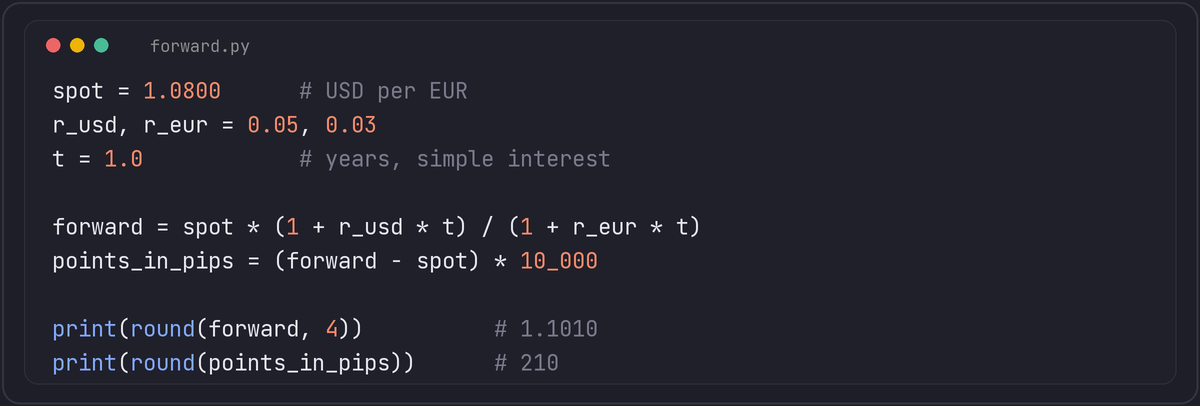
With EUR/USD as the pair, the forward is the spot rate multiplied by (1 + dollar rate × t) and divided by (1 + euro rate × t), where t is the fraction of a year. For longer periods, compounding conventions and day counts apply, and market quotes follow the conventions of each currency.
An example with round numbers
Take spot EUR/USD at 1.0800, a dollar rate of 5% and a euro rate of 3%, both simple annual rates, for one year. The forward is 1.0800 × 1.05 / 1.03 ≈ 1.1010. The difference from spot, about 0.0210 or roughly 210 pips, is the forward points. They are positive because the dollar has the higher interest rate, so the euro (the currency with the lower rate) trades at a forward premium against the dollar. The numbers are illustrative, not current rates.
Forward points are not a view
The change from spot to forward does not say the euro will rise to 1.1010. It says that if you lock the price today, that is the price which leaves you indifferent between the two currencies' interest rates. If spot stays exactly where it is, an investor who holds the higher-rate currency earns the interest difference, and the forward market is the mechanism through which that difference is priced. Whether spot moves to offset the difference is an empirical question that has been studied for decades, and it is unsettled and varies by period.
Where it meets retail forex
- The swap on a retail account is closely related. It is the overnight version of the forward points, plus broker markup.
- A currency swap or FX swap between institutions is a spot deal and an opposite forward deal together, which is why FX swaps are the largest share of the BIS turnover statistics.
- Since the 2008 financial crisis the relationship holds less tightly, and a cross-currency basis appears: the market price of borrowing one currency against another deviates from what interest rates alone imply, particularly for dollar funding. The size of the deviation varies, and it is one of the things funding desks watch.
Treat the parity formula as a model of how the pieces relate. Real forward quotes also include credit and balance-sheet costs, liquidity and settlement conventions.
How points are actually quoted in the market
Institutional and professional forex desks do not usually quote an outright forward price the way the worked example above builds one from scratch; they quote forward points, a small number added to or subtracted from the current spot rate, separately for each standard tenor (common ones include overnight, tomorrow-next, spot-next, one week, and then monthly tenors out to a year or beyond), and the outright forward is spot plus (or minus) those points. A negative points quote means the forward trades below spot, which by the parity relationship above happens exactly when the base currency's interest rate is higher than the quote currency's, the mirror image of the positive-points EUR/USD example worked through earlier where the dollar was the higher-rate currency. Retail platforms that show a single daily swap figure per pair are, in effect, showing the overnight tenor's points already converted into a currency amount for a specific lot size, which is one more way the retail swap figure and the wholesale forward-points quote are the same underlying concept presented for two different audiences.