Perpetual futures: how funding works and who pays whom

Ordinary futures expire, and near expiry their price converges to the spot price. A perpetual contract never expires, so something else has to pull it toward spot. That mechanism is the funding rate.
Who pays whom
At fixed times, holders of one side pay holders of the other. When the funding rate is positive, longs pay shorts, and when it is negative, shorts pay longs. The payment goes between traders, not to the exchange. Since perpetuals usually trade above spot when demand for long exposure is high, funding is more often positive than negative in strong markets, and that gives shorts a cost reduction and longs a cost, but the sign changes with conditions.
You only pay or receive if you hold a position at the settlement moment. A position opened after the timestamp and closed before the next one pays nothing.
How the rate is built
Exchanges publish their method, and the details differ. The common structure, described in Binance's documentation for USDⓈ-M contracts, is:
- a premium index, measuring how far the perpetual trades from the index price,
- an interest component, by default 0.01% per 8 hours (a 0.03% daily figure) for the main USDT contracts,
- a clamp that limits how far the interest term can pull the result, so the funding rate is roughly the premium plus a bounded adjustment.
Contracts also have their own caps and floors on the rate. Settlement was traditionally every 8 hours (00:00, 08:00 and 16:00 UTC), but some exchanges shorten the interval for certain contracts during volatile periods or as a setting, so read the interval per symbol from the API before you assume eight.
The amount
The payment is the position's notional value, measured at the mark price, multiplied by the funding rate.
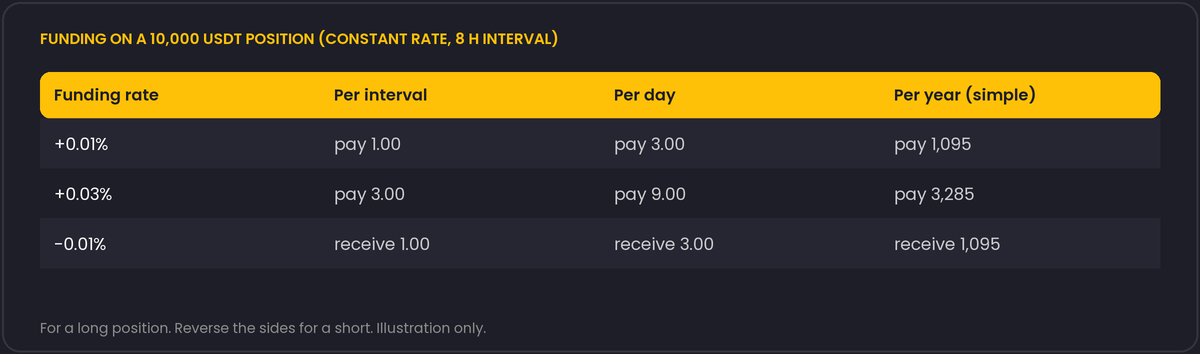
At a rate of 0.01% a 10,000 USDT position pays 1 USDT per interval, which is 3 USDT a day, or about 1,095 USDT over a year if it stayed constant, which it does not. The figure shows why funding becomes a real cost for positions held long and at high leverage, and a small credit when the rate is negative.
Mark price, not last price
Funding and liquidations use the mark price, not the last traded price. The mark price is derived from the index price, which averages spot prices across several exchanges, plus a smoothed adjustment. The point is that a single large trade cannot push the last price far enough to trigger a wave of liquidations. When you read a chart from the last-price feed, remember that liquidation decisions were made on a different series.
Developer notes
- Funding history is available from the exchange APIs. Store the rate, the interval and the timestamp, since intervals can differ per symbol and change over time.
- The rate shown before settlement is a running estimate. The settled one is what got charged.
- Comparing funding between exchanges requires normalising to the same interval, otherwise an 8-hour rate looks eight times bigger than an hourly one.
Coin-margined contracts compute it differently
Everything in the worked example above describes a USDT-margined (linear) perpetual, where the contract, the margin and the funding payment are all denominated in a stable unit. Coin-margined (inverse) perpetuals, where the contract is margined and settled in the underlying asset itself (a BTC-margined BTC contract, for instance) instead of a stablecoin, compute their premium index and funding differently, because the notional and the payment currency are the asset whose price is moving, not a stable unit sitting still underneath it. The mechanical idea, a periodic payment between longs and shorts that pulls the perpetual's price back toward the index, is the same, but the specific formula, the typical interval and the default interest component can all differ between an exchange's linear and inverse contracts for what looks like the same underlying asset. Read the funding specification for the specific contract type, linear or inverse, rather than assuming figures quoted for a USDT-margined contract carry over unchanged to the coin-margined version of what appears to be the same market.